Readers,
Call it Pivot to Video Part Deux, or see it as something akin to the startup boom that came after the ‘90s tech bubble — either way, a significant slice of the media industry is once again gravitating toward video, often through the evolving vessel of podcasting. Among the most prominent players in this shift is the New York Times, whose podcasting ventures have come to double as a kind of indirect history of the medium. Earlier this week, I published a piece exploring how the Times is navigating this new video-first landscape, one that now includes a brand new show built around Wesley Morris. Let’s get to it.
|
|
|
Can the New York Times Turn Its Writers Into Video Stars?
|
|
|
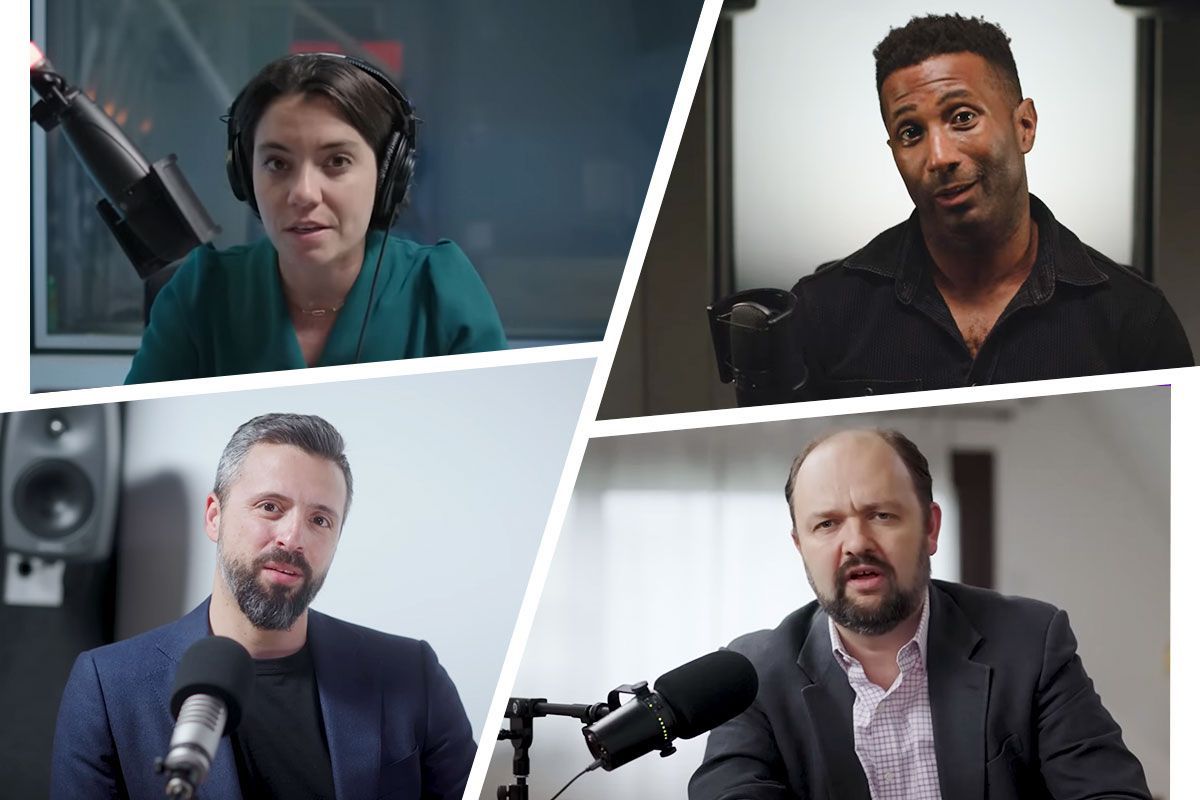
Clockwise from top left: Natalie Kitroeff, Wesley Morris, Ross Douthat, and Ezra Klein. |
“Hold on, I’m going to show you something funny,” Wesley Morris says. The New York Times critic and I are deep into a conversation about a long-simmering anxiety: that digital consumption is rapidly skewing toward increasingly video-centric platforms, potentially marginalizing any media that isn’t primarily visual. He pauses, steps away, and returns holding his copy of New York Magazine — the “Hamptons” issue with Cole Escola on the cover — which had arrived in the mail looking like a cubist fever dream. Someone had apparently taken a paper cutter to it, leaving the issue a near-triangular shape and likely unreadable. Somehow, though, the cover star remained intact. “I’ve never gotten a magazine like this before, but it sure feels like a metaphor to me,” Morris says.
We’re on a video call to discuss Morris’s new project at the Times, Cannonball, a podcast series in which the Pulitzer-winning writer brings on a parade of guests to unpack a different cultural artifact each week. The debut episode, out now, features the culture editor Niela Orr joining him to discuss his love for the unabashedly cheesy Bruno Mars and to poke at the complexities of that affection rooted in the Filipino American pop star’s cozy relationship with Blackness. After the Sean Combs verdict, he recorded an episode to work through his thoughts. Episodes featuring the author Mark Harris on Pee-Wee As Himself and literary critic Parul Sehgal on attention spans are on the horizon.
By now, Morris is an old hand at podcasting. With J Wortham, he spent years co-hosting a well-regarded culture podcast for the Times, Still Processing, which ended in 2022, and more recently, he worked on a Stevie Wonder–focused audio doc for Audible under the Higher Ground banner. Given his stature as a signature voice at the paper, another Morris show was always going to be on the cards, which suited him just fine because he was interested in hosting again. But when Cannonball finally came together, it took an unexpected turn: Midway through the project’s 16-month gestation, the show evolved into a video-centric production.
Morris admits to initially feeling somewhat ambivalent about the shift. While he accepts the strategic need to meet audiences where they are, which today increasingly means video, he’s uneasy about what the change means. “It’s an acknowledgment of how we don’t read as much as we used to,” he says. He also feels that it alters his sense of the job. “I’ll be honest — it was not my first choice. It means I have to be prepared to be public in slightly different ways than I’m used to.” His reaction reminded me of something another host told me when I was putting together last year’s podcast survey: “If we wanted to be in TV, we would’ve gone into broadcast journalism.”
|
|
|
Perhaps it shouldn’t have come as a surprise, but the piece sparked a spicy conversation in the comments section. Some that caught my eye:
“Parts of this article that made me think they're eventually going to just ‘reinvent’ TV news, kinda like how streamers are just becoming cable again. Unrelated, but Marc Maron ending his staunchly audio podcast also seems like a sign of the shifting times.” “Except for Judge and Ohtani home run highlights, nothing should be a video.” “I can't believe we're already back at pivot to video again.” “Jon Caramanica’s car videos are a lot of fun. And as much as I don’t want to think I’m a ‘just give me the 30 second version’ of complex news stories like war, tariffs, and natural disasters, maybe I am. NYT’s videos are concise and plain spoken. Consider me a fan.”
“It is going to differ from writer to writer. Wesley Morris is a handsome, well-groomed, well-spoken polymath who can speak articulately about just about any topic in culture and the arts and look and sound good doing it. Ross Douthat is an infected big toe with no good ideas or actual following. One is likely to work well on video and one is likely not to.” |
|
|
➽ To celebrate podcasting’s twentieth anniversary last week, Apple released an editorial package highlighting what it considers to be the twenty most influential shows. Some unconventional picks in there! But hey, historiography is an evolving thing. Selections include Love + Radio, Moonface, Acquired, The Huberman Lab, and, most recently, a show called Therapuss with Jake Shane.
➽ Did you hear that Smartless is apparently launching its own mobile wireless service? Does it feel like the walls are closing in on you?
➽ Liberty Lost, a narrative podcast led by TJ Raphael, has been hovering near the top of the Apple Podcast charts for the past few weeks. It explores the unsettling rise of so-called maternity homes through the story of one pregnant teenager fighting back against the system.
➽ Speaking of YouTube and charts, I’m picking up an interesting sentiment about the recently launched YouTube podcast charts during my chats of late: people are happy to have it, but for the most part, they’re still not quite sure what to make of it. |
|
|
| A newsletter about the perpetual Hollywood awards race. |
|
|
https://linkst.vulture.com/oc/626feb955dd66aad1f060840o6jba.3y9/d79f6fdf
|
|
|
|