| How’s the masked parkouring Parisian doing? What happens to that person after the Olympics ceremony? Do they get to summer in Provence, like every other Frenchperson? Do they pay taxes? Do they have a day job? So many questions. |
| Enjoying 1.5x Speed? Feel free to send this newsletter to your buds, and click here to read previous editions. And hey, feel free to write me anytime: nicholas.quah@vulture.com. |
| Want more recommendations from our critics? Subscribe now for unlimited access to Vulture and everything New York. |
 |  | | Photo-Illustration: Vulture | | | | Last week, New York Public Radio announced that Brooke Gladstone, the venerable host of the venerable institution known as On the Media, officially has a new partner in crime: Micah Loewinger. This was a bit of a surprise to me, because I feel like I’ve been hearing Loewinger splitting mic duties with Gladstone for so long I swear he’d already been the show’s co-host for years. |
| Turns out, not quite. Loewinger has been at On the Media for almost eight years, spending the bulk of that tenure as a producer and then, eventually, as the show’s first-ever staff reporter. The show typically favors multi-segment episodes that unpacks the week’s media and politics-related news cycles, but Loewinger’s reportage brought longer-form stories into the mix, like this piece on a Syrian refugee camp in a Swedish Wild West theme park, which won a Livingston award, or this collaboration with Death, Sex, and Money that functions as an extensive profile of Tasha Adams, the wife of Stewart Rhodes, who founded the far-right militia group known as the Oath Keepers. Indeed, Loewinger has a special interest in the Oath Keepers: his reporting on the groups use of a walkie-talkie app called Zello during the January 6th insurrection got him subpoenaed, and he was made to testify in the trial against the group. |
| I like Loewinger’s work a lot, and as a devoted listener of On the Media, I figured this was a good opportunity to check in with the guy about the official appointment, how he views his place in the show, and the topics he’s interested in tackling moving forward. Oh, and of course, the elections. |
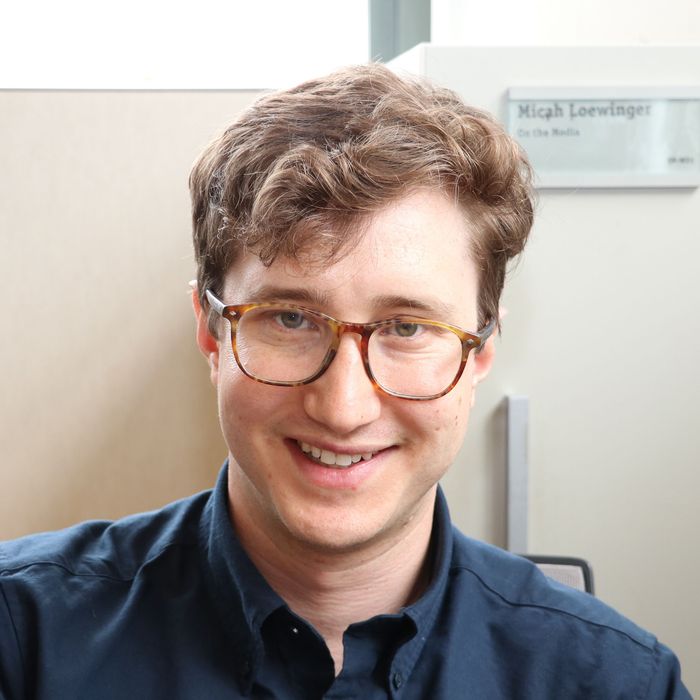 | 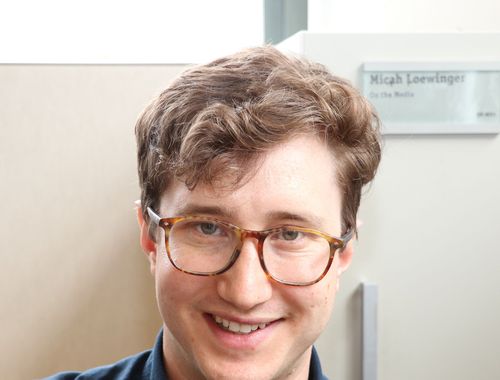 | | Micah Loewinger Photo: Theodora Kuslan |
|
I’ll be honest: I thought you were already the official co-host this whole time, because I’ve heard you so much on the show over the past year. What was the ramp-up to this role like? |
| Well, I mean, to go back even a little further, I started at the show as a temporary producer back in 2016, and after about four or five years of producing, I was promoted as On the Media’s first staff reporter. For the most part, I was doing investigative stories, human interest stuff, and increasingly, these larger, multiple-act stories that could stretch out over an entire fifty-minute episode. |
| Then I started guest-hosting every few months, and sometime last year, I started blending my work as a reporter with discrete interviews about the news for the show. So it was kind of a slow ramp-up to last October, which is when I started guest-hosting every week. That’s when I really got the taste of the weekly news cycle, and what it means to be a host when you’re watching the news unfold throughout the week. It’s a new dynamic, one that I studied very much as a producer, but it definitely feels quite different when you’re in the hosting chair. |
| Has it been tough settling into the hosting role? |
| You know, I actually thought it would be a harder transition. But having worked at this show for eight years, I’ve studied up on the On the Media lens — this slightly idiosyncratic sensibility we apply to the news cycle and thinking about how media narratives are shaped. So the intellectual part of the job was already in my DNA. Also, our team of producers are really great, and I work well with them. These people were my colleagues, and so there’s a deep trust and familiarity between us. |
| Of course, Brooke is an incredible mentor as well. She would listen to my interviews, offer me very honest feedback, and she’d share little tricks for moving through information quickly in a conversation. This is my home, you know? This is the only show that I’ve worked for professionally, so none of it was really new. |
| Is it intimidating to become Brooke’s equal, given her stature and tenure at the show? |
| It used to be more intimidating. I have an incredible amount of respect for her. When she disagrees with me, I always listen. And I will say, the amazing thing about her is that if you tell her that she’s wrong, she will listen. She often changes her mind, which is an incredible quality in a leader — and she really is the leader of the show. |
| That said, it’s not like she’s easy to convince. If she thinks you’re full of bullshit, she’ll tell you. But we do have a genuine friendship. We really like each other. We laugh at each other’s jokes. I think she appreciates that I’m different from her, and she celebrates it. |
| I’m guessing one of those differences is generational. How old are you? |
| Geez, you’re way younger than me. As someone in his early thirties, I imagine you experience media and politics very differently from her. How do you differ from what On the Media’s perspective has historically been as an institution? |
| I mean, there are some strong similarities. I read the New York Times, the Washington Post, the big magazines. So it’s not radically different. But one big difference is that I don’t go home and turn on cable news at night. That’s more common for an older generation of journalists and news consumers. |
| I’ve always been more interested in YouTube and social media, just seeing a different cohort of journalists and commentators. In some ways, this giant revolution that we’re living through, or whatever you wanna call it, where short-form media seems to be devouring so much — it’s a big scary transition, but it feels normal to me as someone who’s been living through it since I was a teenager. |
| What’s your media diet like? |
| I listen to a lot of public radio. Maybe that’s the old person in me. I do love this medium. I’m very committed to it. I’m also on social media a lot, lurking around. I’m on all kinds of different communities on Reddit, and I spend a fair bit of time on more conservative subreddits to see what they’re talking about and the memes or articles they’re sharing. |
| I do like TikTok. I spend more time on Instagram than on TikTok, but I do try to look at TikTok a few times a week. |
| So, the media business has been in some form of crisis on so many levels for so many years now. As the co-host of On the Media, do you feel like it’s difficult to constantly have to say something new about that? |
| Is the media in crisis? That’s what it feels like to me, sure. You see newspapers and digital media sites shutting down and doing big waves of layoffs. Polls indicate that trust in the media is hitting new lows. People say they’re less engaged with the news, period. That all feels like a crisis, certainly. But I do think it’s more complicated than that. People are still consuming news, but they’re just getting it from different places. TikTok and Instagram, increasingly. YouTube and podcasts, increasingly. I don’t think journalism is going away, but it’s shape-shifting and there are all kinds of consequences to that. |
| One thing I think about a lot with traditional newspapers and digital sites dying is what this all means for accountability reporting. One of the great things about the old newspaper bundle model is that the sports coverage, entertainment news, crossword puzzle, etc subsidize investigative reporting and coverage of local government. As more journalists get laid off and try to go solo, you can obviously still find fantastic journalism on Substack and the video platforms. I think that those sites can work really well for cultural criticism and political commentary. But I do worry that the less “glamorous” accountability reporting, especially the kind that takes months to report out, doesn’t translate as well to the creator economy and will be harder to sustain through newsletter subscriptions or what have you. |
| I’m probably more alarmist about it than Brooke. She has a much longer view. There’s been many ebbs and flows throughout her twenty years hosting this year, and her time before that as a media reporter for NPR. She did an interview on the Longform podcast several years ago, and she said something can be easily said today. There’s lots of uncertainty. Younger generations of journalists are very frightened seeing opportunities dry up. But it’s always been like this, to some degree. It’s easy to think that this moment of instability was preceded by some golden age where everyone really trusted mainstream news and all young journalists had a shot at bountiful jobs. But there’s a longer story there. |
| Looking forward, what topics are you interested in tackling more of? |
| As I mentioned, I’m really interested in YouTube. It’s one of my favorite things in the world and it has been for a long time. I see a lot of great investigative journalism about YouTubers and the creator economy by YouTubers — people like CoffeeZilla or Hbomberguy. I’m always so jealous when I see those videos because they’re so entertaining and well done. And it’s so hard to make! I would love to expand the aperture of what we consider to be media, and bring in more analysis about all kinds of creators on YouTube, Twitch, TikTok, etc. |
| The other thing I’m thinking about is how paramilitary groups are organizing around the election. Some of my most impactful stories were about right-wing militias and their use of this walkie-talkie app called Zello. I took a break from that style of reporting and monitoring those communities, but I’m ready to fold it back in. |
| Last question. We are obviously in the middle of an insane stretch of the election news cycle. Lots of narratives are still being formed and litigated as we speak, but from your perspective, what’s an underappreciated thread that’s catching your attention? |
| Yeah, wel l… I was most interested in the last thing he said when we spoke, which was that a lesson he thinks we can learn from Biden’s decision to step side — and the big burst of excitement around Kamala Harris we saw in the first week of her candidacy — is that we truly don’t know how people are going to respond to things. So we should maybe try to have more humility when it comes to prognosticating about how things are going to play out with voters. That’s just a good attitude to have. Sometimes, the people who make the big predictions about what’s been, so far, an utterly unpredictable race really don’t know what they’re talking about. |
| ➽ Wrote a longer review of Hysterical, which I loved. |
| ➽ Hold on, Gavin Newsom has a podcast? With Marshawn Lynch? (And some guy named Doug Hendrickson?) And the New York Times sourced it as a way to report on his response to the news that Kamala Harris is taking over the Democratic ticket? You know, that checks out. Anyway, he was apparently working out when he heard about the development, which is very on-brand. How many podcasts hosted by would-be could-be presidential candidates are we up to these days? |
| ➽ I’ve been hearing for quite some time now that The Rest Is History, made by Goalhanger Productions, is a pretty sizable operation these days. Anyway, the network is launching a miniseries on the French Revolution, hosted by The Rest Is History mainstays Dominic Sandbrook and Tom Holland, that’s obviously timed to the Paris Olympics. |
| ➽ Just want to watch gymnastics this Olympics cycle? We got you. |
| ➽ Sad to hear that John Mulaney apparently won’t be hosting the Oscars next year, according to Puck. (Mulaney was said to be second-in-line after Jimmy Kimmel declined to re-up.) Mulaney, who essentially auditioned for the gig in a short spot in this year’s ceremony, would’ve been the steadiest option. Now, chaos. Which isn’t necessarily a bad thing? |
| And that’s a wrap for 1.5x Speed! Hope you enjoyed it. We’re back next week, but in the meantime… |
| | |